
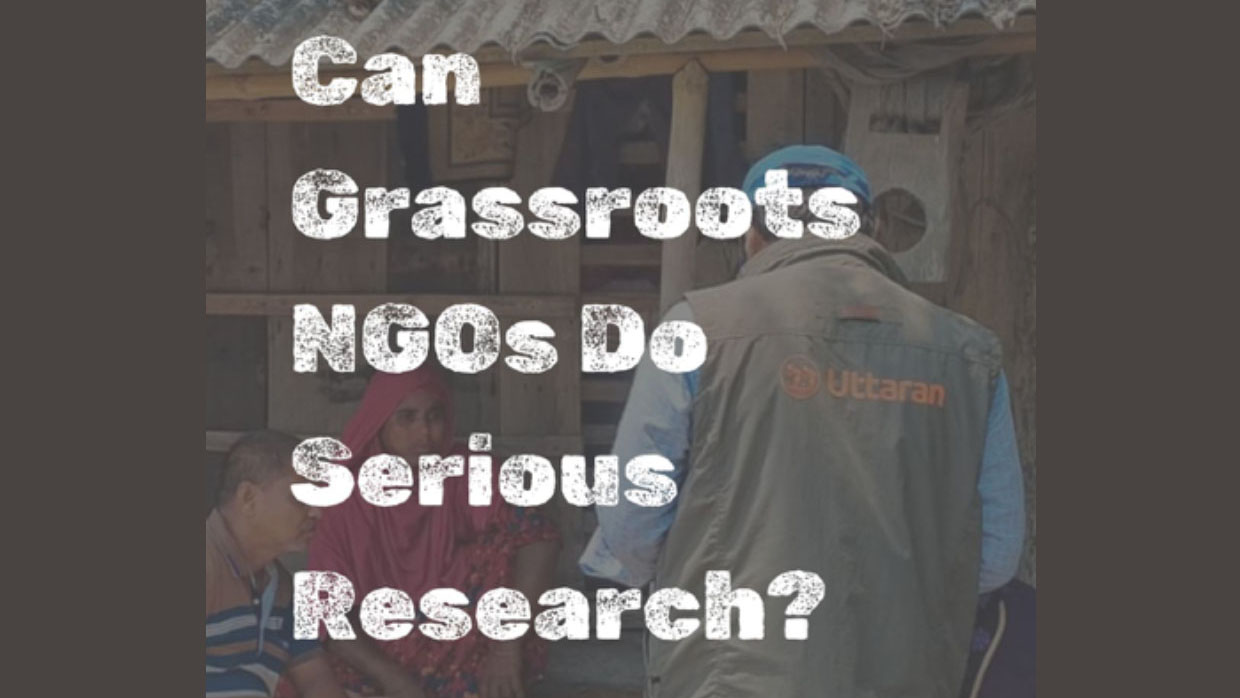
Academia has the tools. Grassroots organizations have the reach, the trust, and the lived knowledge. As a grassroots organization, we may not always publish in journals, but we do live in the data.
Much of what NGOs produce is grey literature i.e., reports, field notes, evaluations, case studies, and community documentation. These are often context-rich and deeply relevant, but because they do not follow peer-review conventions, they remain less visible and less cited. Studies show that while grey literature shapes policy discussions, its credibility suffers without clear methodology and rigorous documentation.
NGOs also face structural barriers. Unlike universities, which have research councils, peer-review mechanisms, and institutional research grants, grassroots organizations rarely receive dedicated funding for research. Most project budgets prioritize service delivery, leaving little space for methodological training, software, or publication support. Without long-term, flexible resources, it is difficult for NGOs to move from program data to rigorous, citable research.
At the same time, NGOs bring something academia cannot: proximity, trust, and lived knowledge of communities. This means our questions are socially relevant, our access to field realities is immediate, and our evidence captures nuances often missed by external researchers. But to maximize this contribution, partnerships and investments are essential.
What would it take?
- Dedicated research funding streams for grassroots organizations.
- Capacity-building in methodology, data management, and ethics.
- Co-production models where academics and NGOs jointly design and implement studies.
- Platforms to standardize, publish, and share NGO-generated data.
- Recognition of NGO staff as co-authors and knowledge producers.
Grassroots NGOs already generate indispensable evidence for development and policy. With modest investments in capacity, resources, and collaboration, we could make this evidence more rigorous and more influential.
It is time for grassroots NGOs to be recognized as an integral part of the larger research ecosystem. Our knowledge, when supported with resources and methodology, can stand alongside academic outputs in shaping policy and practice.
- What might development look like if NGO-generated insights were treated with the same weight as journal publications?
- What innovations could emerge if academics and communities co-produced knowledge as equals?
- And how much more impactful could policies be if they were grounded in both evidence and lived realities?
The bridge between institutions and communities is waiting to be strengthened. The question is – will we walk across it together?
Writer:
Nibraz Bahar
Grants Officer, Uttaran